art notes live here
Paintings, performances, art that inspires or provokes and small arguments with images can collect in this middle box.
Anti-capitalist Art: Luke Winter
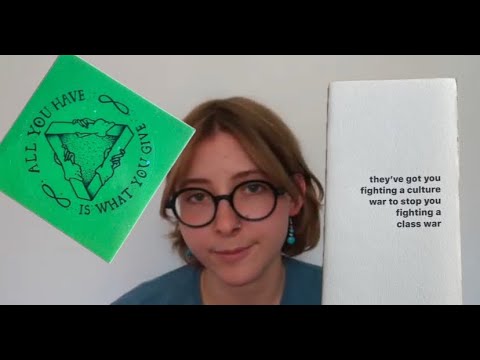
Anti-capitalist Art: Elias Sime
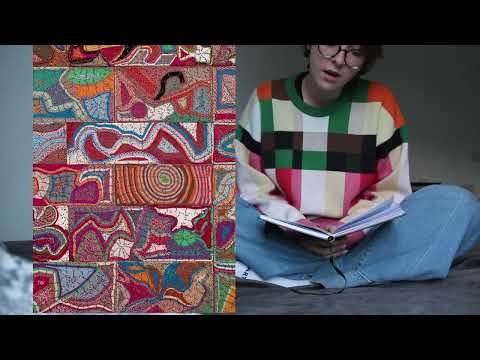
Bewegtes Land - Datenstrudel (2017)
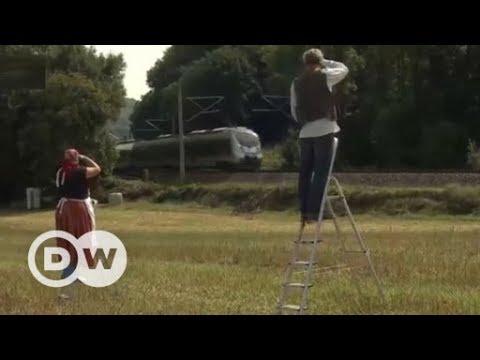
Time seems to work differently when I am sitting on public transportation. Listening to music, starring out at flashes of reality passing by, I let myself get sucked into an alternate dimension. I often imagine the scene playing in front of my eyes to be part of a movie. Making up stories about the characters or the landscape around me, I fall into a trance-like state. Or I get sucked into my phone, ignoring everything around me. The average person spends about a third of their life asleep, five years waiting in traffic and queues, four years doing housework (more for women), one year looking for lost possessions and only two weeks of their life kissing another person. In their Theatre performance "Bewegtes Land" (2017) Berlin based Artist Duo "Datenstrudel" realises the potential of 'unused' time, using art to create random moments of togetherness.
Over the span of one weekend in August 2017, Jörn Hintzer and Jakob Hüfner brought together around 500 residents and volunteers to perform over 40 theatrical pieces. But these pieces were not presented in a regular artistic context, their stage was a 30km long stretch along train tracks between the cities of Naumburg and Jena in rural central Germany. The mini-plays included everything from people disguised as bushes running over a field, a car race between traditionally East German 'Trabants' from the GDR and a modern VW, to people along the track dressed in the same outfit pretending to outrun the train. Passing tiny villages, castles, cliffs and forests, playing with expectations of contemporary social etiquette, these performances embodied an interweaving of different worlds; reality and fantasy, the urban and the rural, speed and slowness & the east and the west.
Hintzer and Hüfner, both media professors at Bauhaus University Weimar, explained that they intended flashes of art gifted to passengers to mirror flashes of media, which we soak in every day. The project gave students from the university a chance to engage with live art, brought together small communities, helped integrate an American PhD student researching local life and amused 24 train loads of passengers. I love the idea behind all of this so much because it truly captures an important aspect of what art can achieve. Often it is not only about the final product but just as much about the process. The whimsical randomness of fleeting moments of pure joy and humanity. Posing questions about how we interact with ourselves and one another on a daily basis, and creating space for community in a society that is not structured in a way which encourages it. 😻
watch on YouTubeShoot an Iraqi - Wafaa Bilal (2007)
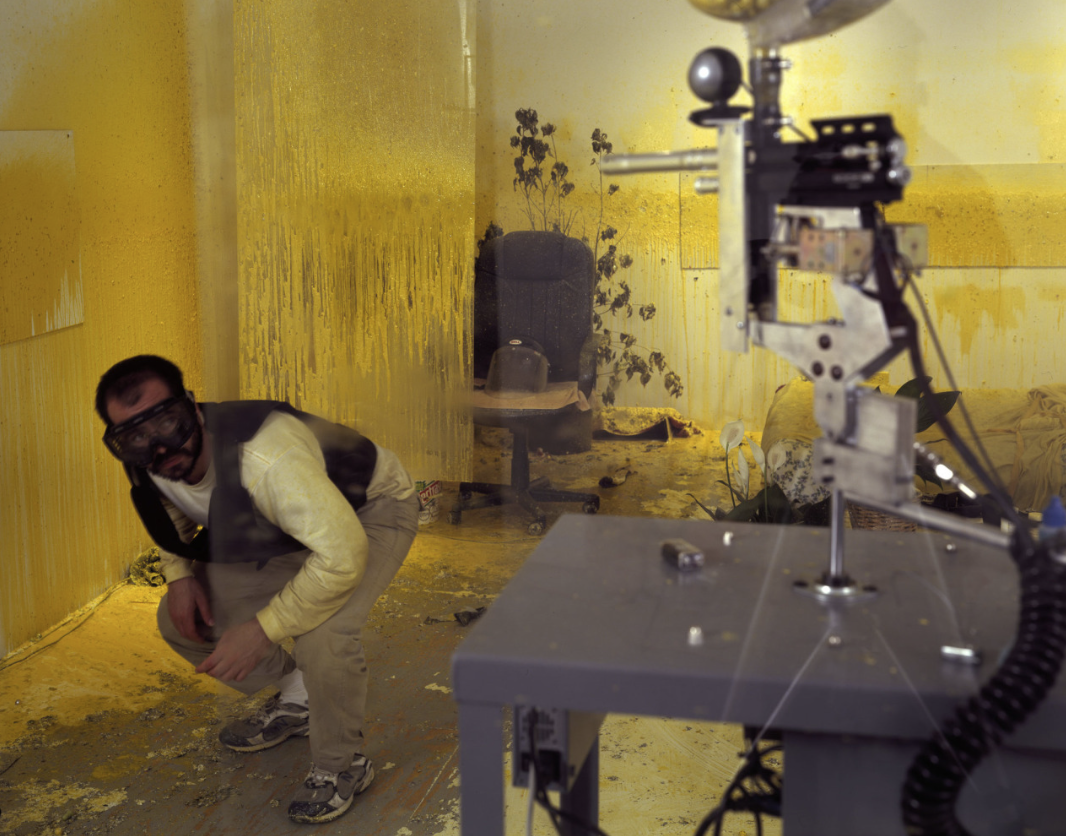
Imagine this; Over the span of one month, you are locked away, alone, in a prison-cell-sized white room, in line of a remote-controlled paintball gun that is hooked up to a camera broadcasting the space, giving Internet viewers the option to shoot at you 24 hours a day. As more and more people let go of their inhibitions, paint is everywhere, and the walls surrounding you slowly fade from white to a musty yellow. That is partly what happened during Wafaa Bilal's 2007 interactive performance piece "Domestic Terror", initially called "Shoot an Iraqi".
The artist's childhood in Iraq was very different from the life he came to live as an adult in the US; defined by "the horrific rule of Saddam Hussein, two wars, a bloody uprising, and time spent in chaotic refugee camps in Kuwait and Saudi Arabia." His brother was shot dead by an American soldier in Najaf in 2005, and shortly after his father was also killed. Although the artist himself now is a professor with a successful career living in the US, that reality was far apart from the daily lives of members of his family in Iraq at the time of his performance. This is what he attempts to highlight; visualising the realities which dominate a lot of Iraqis lives but within a seemingly parallel universe (the US), making these realities seem absurd at first glance. Bilal describes his family only ever leaving their homes when absolutely necessary, trapped inside because of safety concerns. In a way, his performance could also be seen as a desperate scream, a determined attempt at feeling closer to his loved ones. For the audience and shooters online the sound has been removed, mentally removing the implications of their actions as they cannot hear Bilal's reactions to their shooting. "That's how we see this war, as a video game. We don't see the mutilated bodies or the toll on the ground." But Bilal himself hears and feels every shot that hits him or his surroundings.
Through all of his pieces, the artist attempts to quite literally embody the past and ongoing disastrous consequences that the American invasion has had for life in Iraq and Iraqis in general. He utilises a typically more disengaged audience, making them complicit in the personification of his pain. This blurs the boundaries between real and virtual, imagined and experienced, seen and felt and proximity and distance. Another one of his pieces, a 2010 24h live performance titled "and Counting...", consisted of him getting tattooed nonstop on his back. The relentless and haunting sound of the tattoo machine eternally marking his naked body gives a voice to the horrors committed and felt. One red dot for each of the 5,000 dead American soldiers and one green dot for each of the 100,000 Iraqi casualties, forming a borderless map of Iraq around the names of its cities. But the green dots are only visible under UV light, hiding their existence in daylight. "How do you remember a human being that's been killed by an aggression? I wanted to create that monument, one I could carry with me" (Bilal, Goodman, and Kamat 2010).
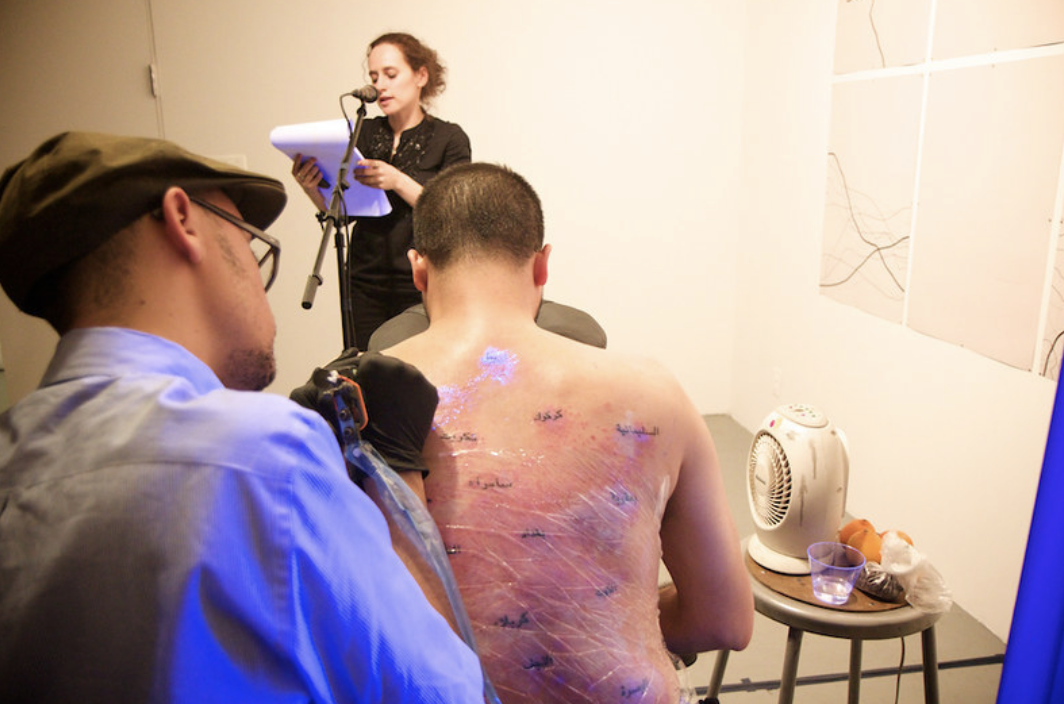
Memory, Dignity and Respect; Bilal's work is a plea for humanity. An attempt at creating an alternate space, if only imagined, trying to create a bridge of some level of understanding or empathy between the parallel worlds that have emerged on this planet.